
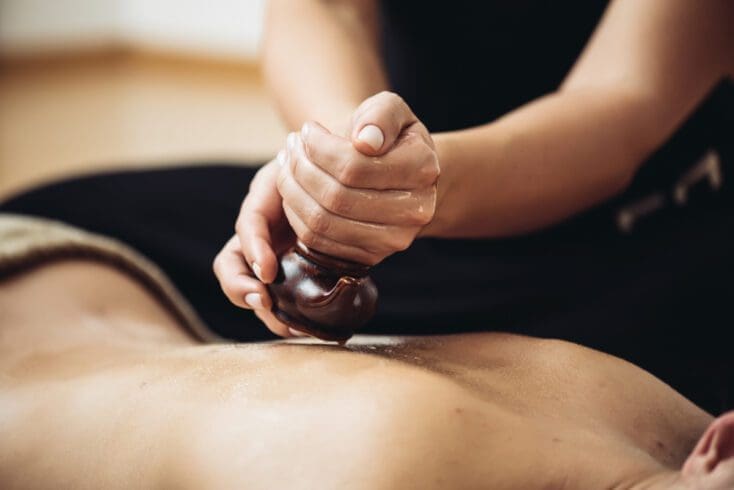
What Is Tantra? The Roots of Tantric Massage
Table of Contents
Tantra is a word you see on almost every London massage site, and almost nobody explains it. Most pages use it to mean something slow and sensual, then move on. The real story is older and more interesting than that.
Tantra began in India more than fifteen hundred years ago. It was a body of texts and practices, not a single religion. It shaped both Hinduism and Buddhism. Sex was part of it for a few schools, but only a small part, and never the main point.
This guide covers where the word came from, what tantric practice actually involved, and how a set of Indian ritual texts turned into the tantric massage you can book in London today. If you want the practical side first, read what is tantric massage. If you want the background, keep reading.
Where the word tantra comes from
Tantra is a Sanskrit word. The root tan means to stretch or to extend, like thread pulled across a loom. Britannica translates the name of the texts, the Tantras, as Looms.
That image tells you a lot. Tantric texts wove together things that other traditions kept apart. Body and spirit. Ritual and ordinary life. Desire and discipline. Where much of Indian religion of the time asked you to withdraw from the world, tantra asked you to work through it.
The word also had a plain, everyday use. A tantra could simply be a manual or a treatise on a subject. Not every text called a tantra is spiritual.
What tantric practice actually involved
Tantric texts start appearing in India from around the fifth century onward. They belong to Hindu traditions, to Buddhist ones, and later to Jain ones too. There was never one tantra. There were many schools, and they often disagreed with each other.
What they shared was an attitude. Most spiritual paths of the period treated the body as a problem to be managed. Something to fast, to control, to escape. Tantra took the opposite view. The body was the tool, not the obstacle.
The practice itself was mostly ritual. Mantras, which are sounds repeated until the mind settles. Mandalas and yantras, which are drawn diagrams used to hold attention. Initiation by a teacher. Long stretches of visualisation. Worship of the goddess and of Shakti, the active creative energy that tantric texts place at the centre of things.
Sexual ritual did exist in some schools. It was rare, hedged with rules, and reserved for advanced practitioners under supervision. It was never the daily practice of tantra, and it was never about pleasure on its own.
Breath, energy and the subtle body
One tantric idea carried into nearly everything that came after it. The subtle body.
Tantric texts describe a system inside you that you cannot see. Channels called nadis carry a life force called prana. Points along the spine, the chakras, are where that force gathers. In some Hindu tantric texts an energy called kundalini rests at the base of the spine and can be woken through practice.
You do not have to take any of that literally for the practical part to work. Slow breathing genuinely changes how you feel. The NHS publishes breathing exercises for stress that rest on the same simple idea. Lengthen the breath, and the body settles.
That is the honest bridge between a fifth century Indian text and a massage table in Marylebone. The language is old. The effect of slowing down and breathing properly is something you can test on yourself in two minutes.
Four things people get wrong about tantra
Tantra attracts more myths than most subjects. These four come up again and again.
That tantra is one tradition. It is not. Tantric texts run across Hinduism, Buddhism and Jainism, across several centuries and several regions of India. Schools argued with each other about method and meaning. Treating tantra as one fixed system is like treating all of European philosophy as one idea.
That tantra is mainly sexual. The bulk of tantric practice was ritual and meditative. Sexual ritual belonged to a minority of schools and even there it was an advanced practice with strict conditions. The modern link between tantra and sex says more about the twentieth century West than about India.
That tantra is about lasting longer. This one comes almost entirely from modern books and workshops. Classical tantric texts are not concerned with sexual performance. They are concerned with ritual, with the goddess, and with the practitioner’s relationship to the divine.
That tantra is ancient in its current form. The ideas are old. The London tantric massage market is not. It took its present shape in the last fifty years or so, and it keeps changing.
Knowing this does not make a tantric massage less worth booking. It just means you go in with an accurate picture instead of a marketing one.
How tantra became tantric massage
Here is the part most massage sites leave out.
Tantric massage is not an ancient practice. No classical Indian text describes it. What you can book in London today comes from neotantra, a Western movement that took shape during the twentieth century.
Neotantra borrowed the vocabulary of Indian tantra and put sexuality at the centre of it, which classical tantra never did. Teachers in Europe and the United States built courses, workshops and bodywork around that idea from the 1960s onward. Tantric massage grew out of that work.
Saying this plainly is not a criticism. A tantric massage does exactly what it says. It is slow, it works with the breath, and it treats the whole body rather than one sore shoulder. But it is a modern practice built on old ideas, not a ritual handed down unchanged for fifteen centuries. Anyone who tells you otherwise is selling you a story rather than a massage.
What tantra means in a massage session today
Strip away the marketing and three things carry over from tantra into a good session.
Slowness. Nothing is rushed. A tantric massage is built around long, unbroken strokes that cover the whole body. This is why sixty minutes often feels short and ninety minutes feels right.
Breath. Your masseuse pays attention to how you are breathing and may ask you to slow it down. This is the most direct link back to tantric practice, and it is the part first time clients notice most.
The body as the route. Classical tantra treated the physical world as the way in rather than something to get past. In a session that shows up as attention on the whole experience instead of on reaching a finish. You can read more about the benefits of tantric massage and what people take away from a session.
Where to book a tantric massage in London
Aisha Massage has arranged tantric massage in London since 2015. We are an agency, not a venue. The masseuses are independent, they work from private addresses, and every one is met in person before she joins.
A few who take tantric bookings regularly:
Chloe - Oxford Circus

Yasmin - South Kensington

Laura - Marylebone
You can browse every profile on the masseuses page. If this is your first booking, read how to prepare for your first tantric massage first. Session lengths and prices are on the rates page.
Popular areas include tantric massage in Mayfair, tantric massage in South Kensington, tantric massage in Knightsbridge, tantric massage in Soho and tantric massage in Covent Garden. The full list is on the locations page.
Incall means you visit a private flat. Outcall means a masseuse comes to your home or hotel. Both run across Central London. You can read more about incall and outcall massage.
Ready to book? Call 07482752099 and the team will help you choose a masseuse and a session length.
Frequently asked questions
Is tantra a religion?
No. Tantra is a set of texts and practices rather than a faith of its own. Tantric traditions grew inside Hinduism and Buddhism, and later inside Jainism. A person can practise tantra within one of those religions, or study the ideas without following any religion at all.
Is tantra about sex?
Mostly not. Classical tantric practice was ritual work: mantras, diagrams, visualisation and worship of the goddess. Sexual ritual appeared in a few schools and was rare even there. The strong link between tantra and sex is a modern Western development, not an Indian one.
Do I need to believe in chakras to enjoy a tantric massage?
No. Chakras and energy channels are how tantric texts describe the body. You can treat them as useful language rather than fact and still get everything out of a session. The slow pace and the breathing work whether you believe in the model or not.
What is the difference between tantra and tantric massage?
Tantra is an Indian spiritual tradition going back to roughly the fifth century. Tantric massage is a twentieth century Western practice that borrowed tantra’s ideas about breath, energy and the body. They share a vocabulary. They are not the same thing.
How long has tantric massage existed?
In its current form, a few decades. Neotantra took shape in Europe and the United States through the twentieth century, and tantric massage grew out of that. The ideas behind it are much older, but the massage itself is modern.

